What Does Concealed Unemployment Mean?
When people who are out of work are not counted in official unemployment statistics for a variety of reasons. Those potential workers falling into this category typically include individuals who have given up looking for employment, those who have taken an early retirement even though they would prefer to still be employed and those with seasonal or part time employment. (source: investopedia.com)
This paper will be looking at a Bureau of Labor Statistics definition known as “Not In the Labor Force” (NILF). The NILF can conceal problems in Unemployment indicators and labor supply/demand problems caused by increased Population.
Definitions for this document:
Labor Force: The number of persons Employed plus the Unemployed
Unemployed: The number of persons in the age group who are defined in the U-3 “Headline” unemployment rate
Not In the Labor Force: Persons neither employed nor unemployed
Population: The Non-Institutionalized Civilian Population, those counted in the “Labor Force” plus those counted as “Not In the Labor Force”
BLS CPS: Bureau of Labor Statistics, Current Population Survey
End Definitions:
Chart 1 (Click on charts to enlarge)
Definitions for this document:
Labor Force: The number of persons Employed plus the Unemployed
Unemployed: The number of persons in the age group who are defined in the U-3 “Headline” unemployment rate
Not In the Labor Force: Persons neither employed nor unemployed
Population: The Non-Institutionalized Civilian Population, those counted in the “Labor Force” plus those counted as “Not In the Labor Force”
BLS CPS: Bureau of Labor Statistics, Current Population Survey
End Definitions:
Chart 1 (Click on charts to enlarge)
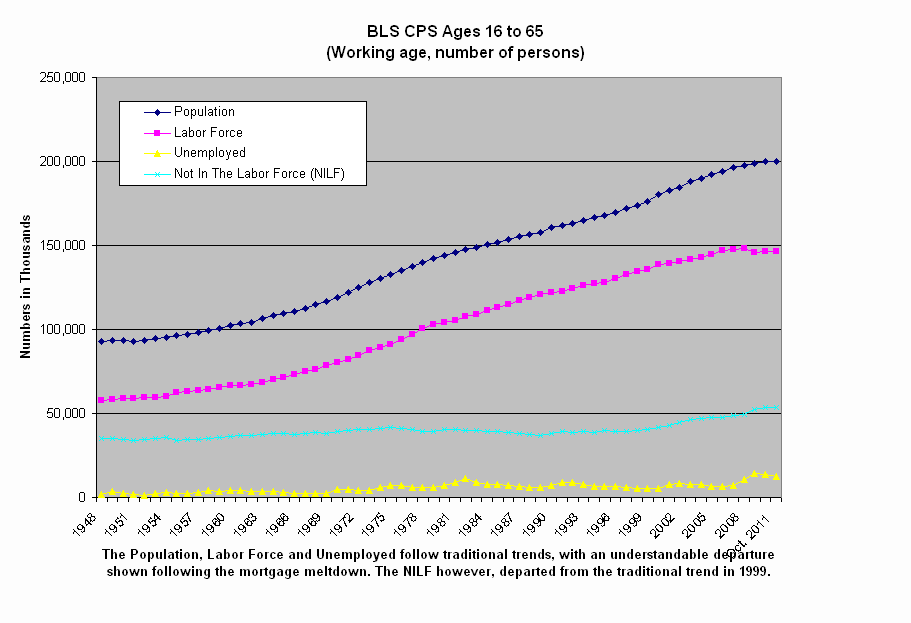
Displayed in Chart 1, is the entire BLS data record for noted classifications for Ages 16 to 65. Chart 1, is provided to display the historical trends in the various classifications in the working age population.
Chart 1 shows the Population, Labor Force and Unemployed follow traditional trends with an understandable departure following the mortgage meltdown. The NILF however, departed from the long-term trend in 1999.
Chart 2

Chart 2 isolates the long-term trends in the NILF and Unemployment percentage rates, reinforcing the observation made from Chart 1.
Chart 3

Chart 3, focuses on 1999 going forward – starting with a fresh count at the end of year 1998. Thus, Chart 3 displays the “change” since end of year 1998.
There is a lot to absorb in Chart 3. Concerning the NILF, the additions to the NILF have exceeded the additions to the Labor Force (Employed plus Unemployed). The NILF accounts for 52.6% of the 26,229,000 added to the working population. Finally, 57.7% of the additions to the Labor Force were in the Unemployed subcategory.
Chart 4

Chart 4 is provided to display that there is a connection to the NILF and the prior few years’ Unemployment levels. The levels of the NILF category traditionally have fluctuated between 35 million and 40 million before a substantial increase of levels began in the late 1990s. Since the end of 1997, NILF levels have increased by 34.8%.
Also noted in Chart 4 is a change in the average Unemployment levels, From 1948 to 1971 the average Unemployment rate was 4.5%, from 1972 forward the average Unemployment rate has been 6.2%. Since 1981 average unemployment rates have increased by 37.2%.
Note: The significance of 1971 is that President Nixon abandoned the Bretton Woods accord and closed the “Gold Window”. The “Gold Window” was an assurance that Federal debt instruments and Reserve Notes could be redeemed in gold. Closing the “Gold Window” caused the oil embargo and gasoline shortages of the early 1970s. Additionally, two severe depressions in Mexico followed President Nixon's 1971 actions.
Chart 5

Chart 5, shows year over year increase/decrease in levels added to NILF, Unemployed and Population. Chart 5 tends to indicate that lower levels of increase in Population level coincide with lower levels of increase in unemployment rates and lower levels in increase in the NILF category tend to follow.
There is always reserve human capital in the NILF and there are many reasons why people leave the labor force, one reason that is rarely discussed is that many self employed persons refuse to work below the cost of doing business.
Chart 6

Chart 6 deals with U.S. born population increases, population increases from immigration and employment level growth in the 16 to 65 age group. The U.S. born population data is births minus deaths in the birth year, with 16 years added to the birth year to adjust the year these children entered the working age Population.
Note: The Population increases from U.S. births and the Employment level increases are directly relational, the portion of Population increase from immigration may contain persons over the age of 65. For completeness, Employment levels have increased by just over 3 million for persons 65 and older since end of year 1998.
In conclusion, it is clear from Chart 6, that employment growth levels no longer support the United States traditional immigration levels. Charts 1 through 5 demonstrate that concealed unemployment causes the headline Unemployment Rate to be far below the actual rate of unemployment.
Data Sources:
=======================================================
Data Sources: US Department of Labor, Bureau of Labor Statistics
Downloaded 10/09/2011
(Ages "65 years and over" are subtracted from "16 years and over" to determine the various levels in ages 16 to 65)
=======================================================
Series Id: LNU00000000
Not Seasonally Adjusted
Series title: (Unadj) Population Level
Labor force status: Civilian noninstitutional population
Type of data: Number in thousands
Age: 16 years and over
Series Id: LNU00000097
Not Seasonally Adjusted
Series title: (Unadj) Population Level - 65 yrs. & over
Labor force status: Civilian noninstitutional population
Type of data: Number in thousands
Age: 65 years and over
=======================================================
Series Id: LNU01000000
Not Seasonally Adjusted
Series title: (Unadj) Civilian Labor Force Level
Labor force status: Civilian labor force
Type of data: Number in thousands
Age: 16 years and over
Series Id: LNU01000097
Not Seasonally Adjusted
Series title: (Unadj) Civilian Labor Force Level - 65 yrs. & over
Labor force status: Civilian labor force
Type of data: Number in thousands
Age: 65 years and over
=======================================================
Series Id: LNU03000000
Not Seasonally Adjusted
Series title: (Unadj) Unemployment Level
Labor force status: Unemployed
Type of data: Number in thousands
Age: 16 years and over
Series Id: LNU03000097
Not Seasonally Adjusted
Series title: (Unadj) Unemployment Level - 65 yrs. & over
Labor force status: Unemployed
Type of data: Number in thousands
Age: 65 years and over
=======================================================
Series Id: LNU05000000
Not Seasonally Adjusted
Series title: (Unadj) Not in Labor Force
Labor force status: Not in labor force
Type of data: Number in thousands
Age: 16 years and over
Series Id: LNU05000097
Not Seasonally Adjusted
Series title: (Unadj) Not in Labor Force, 65 yrs. & over
Labor force status: Not in labor force
Type of data: Number in thousands
Age: 65 years and over
=======================================================
U.S. Born Population Birth/Death Data
=======================================================
Source: U.S. National Center for Health Statistics,Vital Statistics of the United States, and National Vital Statistics Reports (NVSR).
For more information:
http://www.cdc.gov/nchs/nvss.htm
Internet release date: 09/30/2011
http://www.census.gov/compendia/statab/2012/tables/12s0078.xls

